Learn about collaborative modelling methods and establish a shared understanding of processes and requirements.
Many misunderstandings in software development do not arise only during implementation. They arise long before that: those involved use the same terms for different things, view a process from different perspectives or make assumptions that have never been jointly verified.
Collaborative Modelling brings the relevant people together and makes their different perspectives visible. Rather than merely documenting requirements, business experts, product managers and technical stakeholders work together to develop a model of the problem and the business context.
The resulting models are not primarily intended for documentation. They are tools for collaborative thinking, focused discussions and informed decisions. They help to uncover implicit knowledge, identify contradictions and develop a shared vocabulary.
In this training course, you will learn about various methods of collaborative modelling and apply them straight away. You will discover which questions can be addressed using which method, how the methods can be combined, and how the results can be translated into concrete next steps.
The focus is not on learning as many notations as possible. What matters most is the ability to support a group in jointly exploring, understanding and defining a technical problem. This creates a robust foundation for product development, architecture and implementation.
Collaborative modelling methods address different aspects of a business problem. Some help to explore a business process in its entirety. Others focus on specific workflows, user needs or individual requirements.
Architectural Roleplay first allows participants to experience roles, responsibilities and interactions. Event Storming then reveals which business events occur, what triggers them and which decisions process.
Domain Storytelling explores selected workflows in greater depth from the perspective of the people involved. User Story Mapping structures user goals and value-adding activities, whilst Example Mapping refines individual requirements using specific rules and examples.
In the training course, the methods are therefore not treated as separate tools from one another. You will learn to switch between the big picture and the details, to use the results of one method as a starting point for the next, and to model only to the extent that is appropriate for the current issue at hand.
This avoids creating a rigid process model that is applied regardless of context. Instead, you will develop the ability to consciously select methods and combine them into a suitable modelling strategy.
The training course combines brief theoretical insights with intensive practical work. Each method is first categorised according to its objectives and typical application scenarios. Participants then apply the methods themselves and reflect together on the resulting models.
The fictional start-up Produce Paradise serves as the overarching case study. The participants take on different roles and work together to understand the business model, the business-critical process and the resulting requirements.
To begin with, the group uses Architectural Roleplay to explore the roles involved, their responsibilities and their interactions. Event Storming is then used to create a shared understanding of the business events, decisions and cross-functional workflows.
Domain Storytelling is used to explore selected processes in greater depth and bring together different perspectives on the actual workflows. User Story Mapping is used to structure user goals, activities and potential product increments in a structured manner.
Finally, Example Mapping clarifies selected requirements using rules, examples and open-ended questions. To conclude, we systematically compare the methods and develop approaches for applying them within our own working context.
The exact sequence of events is guided by the group’s learning process. What matters is not mechanically following a predetermined sequence, but consciously selecting the methods and applying them effectively to the issue at hand.
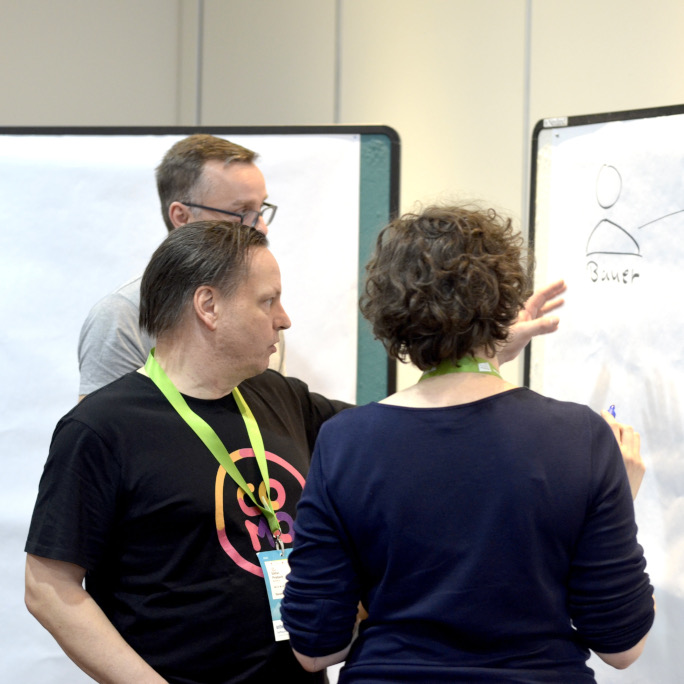
This training is aimed at people who need to work together to understand complex technical issues and translate them into effective software.
It is particularly suitable for product owners, product managers, business analysts, requirements engineers, software architects, software developers, UX and service designers, subject matter experts, process owners, founders and technical decision-makers.
Agile coaches and workshop facilitators will also benefit from the training if they wish to structure subject-matter clarification and decision-making processes more effectively.
The format is most beneficial in groups comprising a mix of subject matter and technical expertise. Diverse professional perspectives are expressly encouraged, as it is precisely these differences that become visible within the shared model and can be addressed productively.
No programming skills or experience with specific modelling notations are required to take part.
Practical experience in product or software development, an interest in business processes and a willingness to actively participate in collaborative modelling are helpful.
Prior knowledge of Domain-Driven Design, agile product development, business analysis or requirements engineering can make it easier to get started, but is not a prerequisite.
What is crucial is an openness to exploring different perspectives, questioning existing assumptions and understanding models as provisional tools for collaborative learning.
Bring together business and technical perspectives and create a robust foundation for product development, architecture and implementation.